

Artwork title : Signal
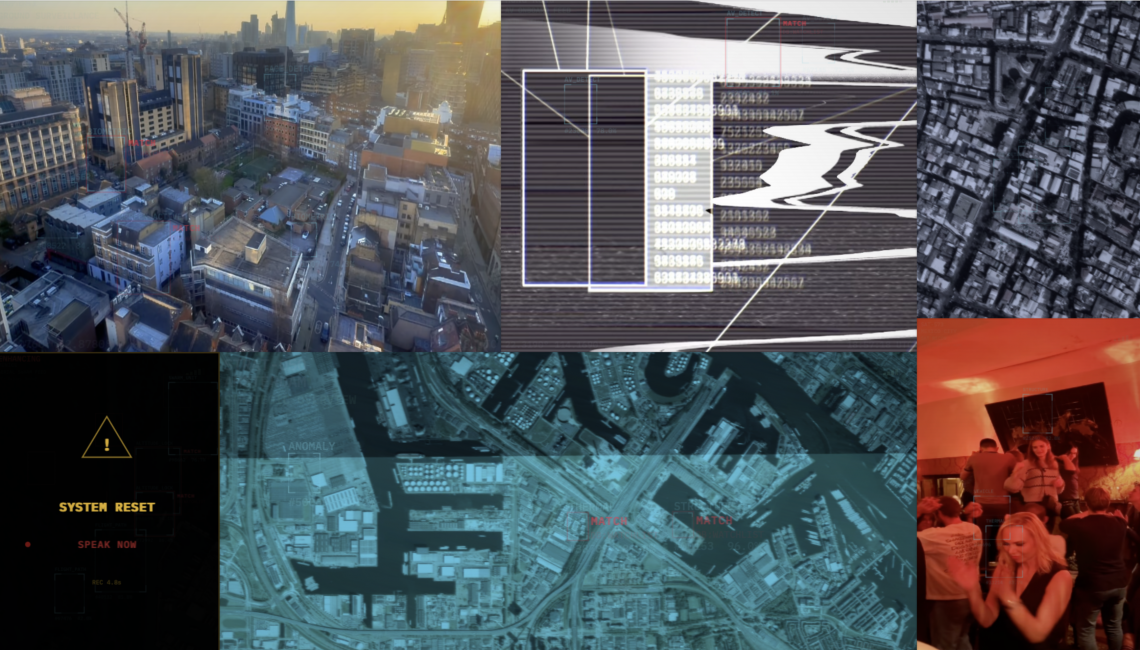
SIGNAL is an interactive installation that stages the aesthetics of a surveillance operations room, combining satellite imagery, street-level navigation, live weather and flight data, thermal camera simulation, and the visitor's own camera feed into a six-panel asymmetric grid that moves and shapes. The work is configured as a two-projection system. The primary projection functions as a surveillance wall where panels (which the audience can move with the gesture of their hands) can cycle between satellite imagery, 3D terrain, thermal rendering, real-time aircraft tracking, and live drone and CCTV-style video. The secondary projection functions as a navigable console, both projections the visitors can speak any city, address, or location aloud using voice recognition and immediately retarget the system, exploring street-level imagery as if operating a remote visual intelligence interface. Gesture interaction is driven by real-time hand tracking, where the spread and pinch of fingers controls zoom level across geospatial panels.
The sonic layer generates evolving environmental atmospheres procedurally rather than relying on soundtrack playback. After the first visitor interaction, the system begins regording all that is in front of it and periodic voice recordings of the user is played back, applying an aggressive processing chain that transforms the visitor's voice into something degraded and ominous through compression, distortion, reverb, and feedback delay loops that fragment speech into echoing repetitions. The visitor hears their own voice returned to them as an unstable affected signal. It is the installation's central metaphor made audible.
The visitor is not positioned outside the system as a passive viewer. Presence, gesture, and voice continuously reposition them between watcher, target, and interface. Threat-style overlays appear on the webcam feed with biometric analysis indicators, while the system folds the participant back into its own feedback loop. Two core interaction modes define the experience. A corruption mode allows visitors to destabilize the surveillance wall through glitch states that bleed between panels, degrading the system's apparent control. A repair mode allows them to restore it, pulling the grid back toward operational clarity. Together they produce a push-pull between agency, control, and breakdown. The corruption mode can evoke the sensation of calling in a drone strike, targeting a location and watching the feed destabilize around it. The person can with their fingers gesture on any of the panels and in the case of distortion will be able to at points point and click and see a drone strike at work. The work turns participation into unease: the audience can target, search, corrupt, repair, zoom, and navigate, but the system is always watching back.
SIGNAL expands beyond biosensing and embodiment into media infrastructure and machine perception, taking hidden or normalized systems and turning them into shared sensory experience. It approaches the relationship between humans, machines, and sonic environments from a politically charged angle, showing that interplay between people and technology is not always harmonious but can be tense, asymmetrical, and implicating.

All right reserved - copyright © Malamegi Lab - www.lab.malamegi.com