
Entropy and Me
Materials:
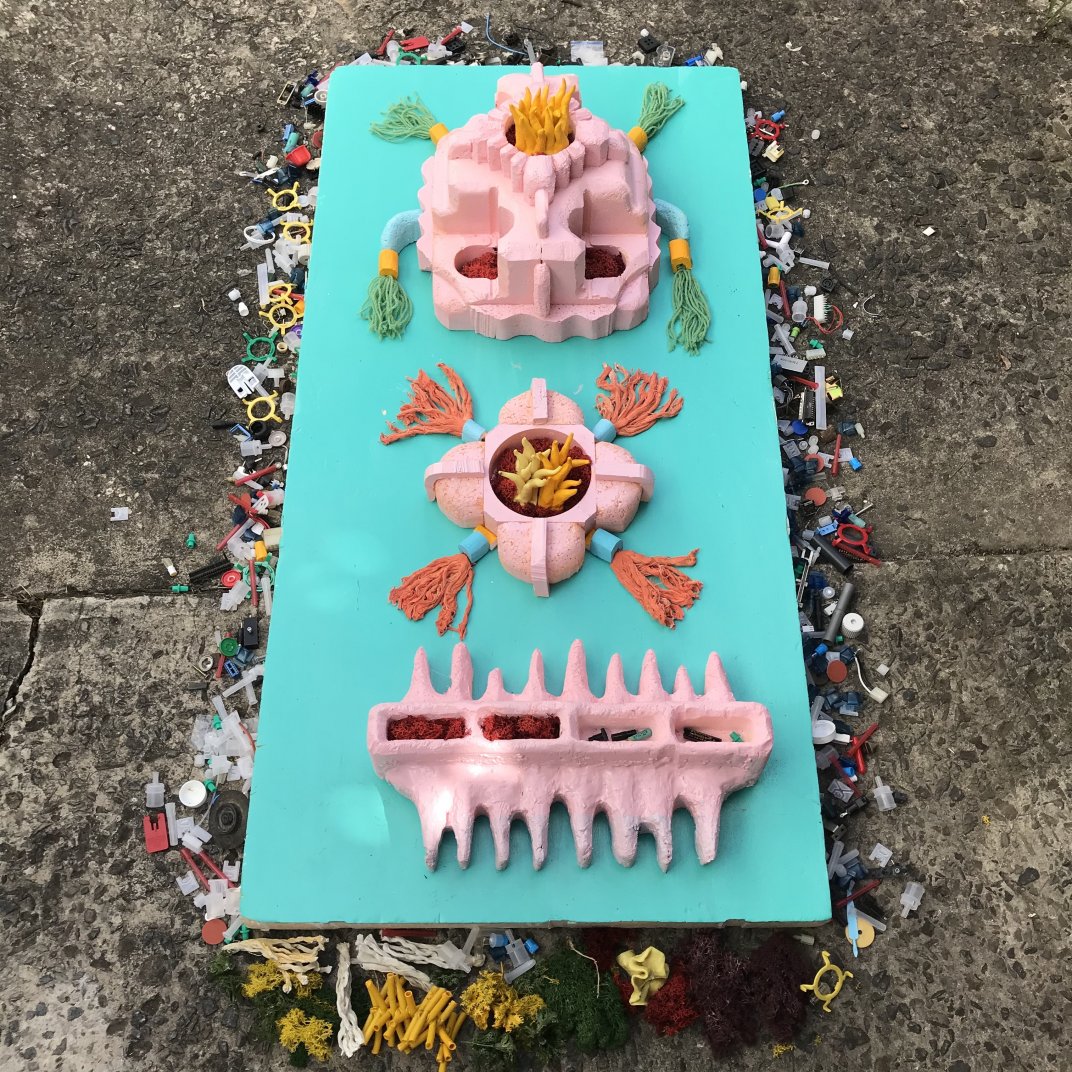
Mixed media sculpture work consisting of: synthetic polymer paint, foam board, discarded polystyrene packaging, rescued wool and cloth tassles, polyurethane resin, lichen, discarded medical intravenous needle paraphernalia, discarded old electronic components and miscellaneous items.
Dimensions:
L 120cm x H 60cm x D variable (33cm max)
Description and installation suggestions:
The work consists of organic like masses on a blue-green background, made primarily of out discarded synthetic and organic materials. On one end of work the forms are rather lively. At the other end is a mass that seems half-formed and bare. Surrounding the piece is assorted medical and electronic junk. At one end of the ‘skirt’ of items are organic like shapes. The work is intended to be placed on the ground, with viewers circling around it as if they were looking at something growing from the surface or that emerged there – although it is clear that it is a made work. Ideally the work would be placed on a rough unfinished surface such as unpolished concrete, but it should work on a number of surfaces.
About the piece:
In 2016 marine scientists found coral bleaching in Sydney Harbour (close to where I live) for the first time and attributed it to global warming. Coral bleaching is occurring on a large scale all over the globe, with Australia's Great Barrier Reef being one of the significant and talismanic casualties. There is a spreading consciousness about this phenomena worldwide as one of the more alarming signs of global warming the world over. As a consequence of this research efforts are underway to grow and transplant heat resistant coral into the worlds diminishing coral reefs. A heroic and characteristically anthropocene reaction. The plasticisation of the world.
I consider this sculptural work to be my own plastic and anthropocene reaction to the ecological change happening in my proximity – although far less valiant and more idiosyncratic than the efforts of the scientists. More a psychological imprint of ecological violence than an activist solution to it. It is an accident or even a side-effect of an artists consciousness immersed as it is in a changing world on the brink of ecological catastrophe. I started off interested in coral like organic shapes, seeking to create constructions inspired by them. I found myself skewing towards negating it in a sense, ‘bleaching’ or mutilating the work by leaving a part of it unfinished and covered in detritus, which also encircles the sculpture. There are tensions here between the plastic and the natural; between the variety of materials used and between the fabricated actuality of the piece and its organic pretensions. I have deliberately chosen polystyrene foam used to pack electronic goods as my main elements. I find the shapes of these packing materials eerily compelling. I have largely retained their original character, which serves to foreground the artificial, man-made, constructed quality of this work. At the same time I have modified or added to it, effacing and hiding its original purpose. The skirt at the edge of a sculpture consists of a detritus of medical equipment and electronics, that appears to be encircling and invading the sculpture. There are bits of degraded coral like shapes on one short edge of the piece that seem to have fallen off the third amoeboid shape, which has in two of its cavities electronic bits rather than organic material. In the anthropocene there is room for only one animal – the human. Humanism reigns. All else must be effaced. The organic shapes here although colourful and inviting are also strange and confronting. They are a reminder that other beings, non-human ones with strange faces and of biological timescales that dwarf and transcend us. But the work doesn’t preach. It is ironic and playful. It is after-all a highly synthetic and very human creation.

All right reserved - copyright © Malamegi Lab - www.lab.malamegi.com