

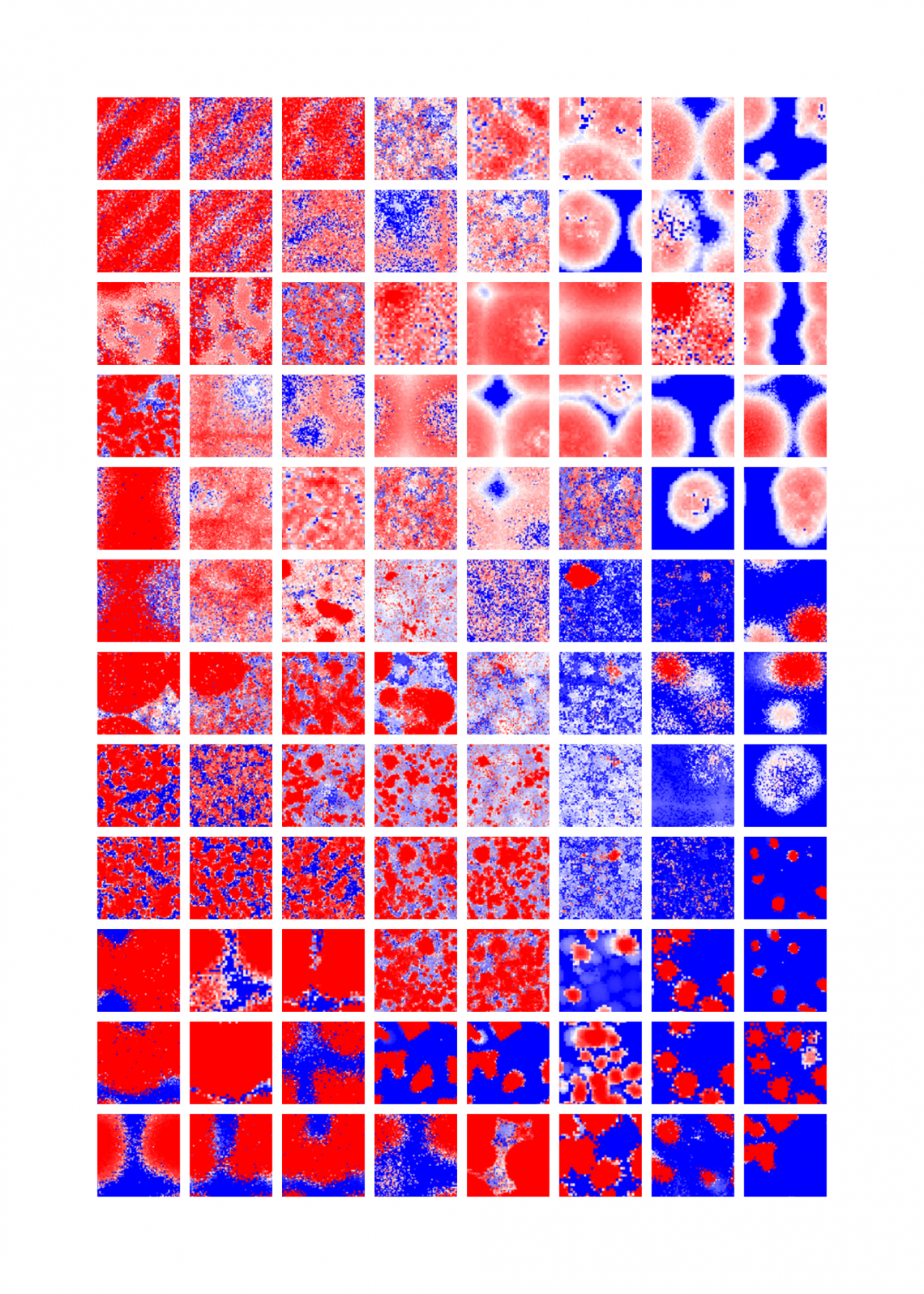
Artwork title : Neural Turing Patterns
Art science is a humanistic expression on the borderline between scientific research and aesthetics. For example, the beauty of a high-resolution microscope image is due to the details and geometries of the shapes it captures, giving the observer a content of truth in addition to the fascination of the image itself. Other examples of images related to the Science of Art are those derived from computer simulations, capable of creating scenarios that are not directly observable with today's technologies, thus capable of going beyond an objective truth, but resisting a possible, plausible, hypothetical truth that is not otherwise observable. This artwork is a collection of multiple simulations of the brain, specifically representing the behaviour of the cerebral cortex. Each square is a network of neural cells that are activated with low (blue), medium (white) and high (red) intensity. Many of them look very similar, while others are very different. Thus grouped, the images appear to have a graphic continuity with those closest to them. But this visual feature is actually a Gestalt illusion, because these are completely independent simulation results. The behaviour of this neural network shows functional characteristics, i.e. patterns of activity of neurons, that emerge spontaneously in the dynamics of the system. These patterns were first studied by the English mathematician Alan Turing (1912 - 1954), who also introduced the concept of the contemporary computational machine. Examples of these patterns are stripes, spots, lattices, tessellations, bubbles, spirals, foams and waves, and many of these themes can be observed in nature, such as the maculae of animal skin or the colours of flowers, the ripples of water, patterns on the seabed, and the developmental stages of embryos. In the specific case of this artwork, a set of Turing patterns is generated by brain simulations, justifying the name 'Neural Turing Patterns'. The artwork was awarded with the Brain and Art prize 2021 by the University of Aix-Marseille and was exhibited at the Marseille Gallery. In addition, in the 'Beautiful Mistakes' section, the artwork won the first prize at the OHBM 2022 (Organization of Human Brain Mapping) conference in Glasgow, UK.

All right reserved - copyright © Malamegi Lab - www.lab.malamegi.com