

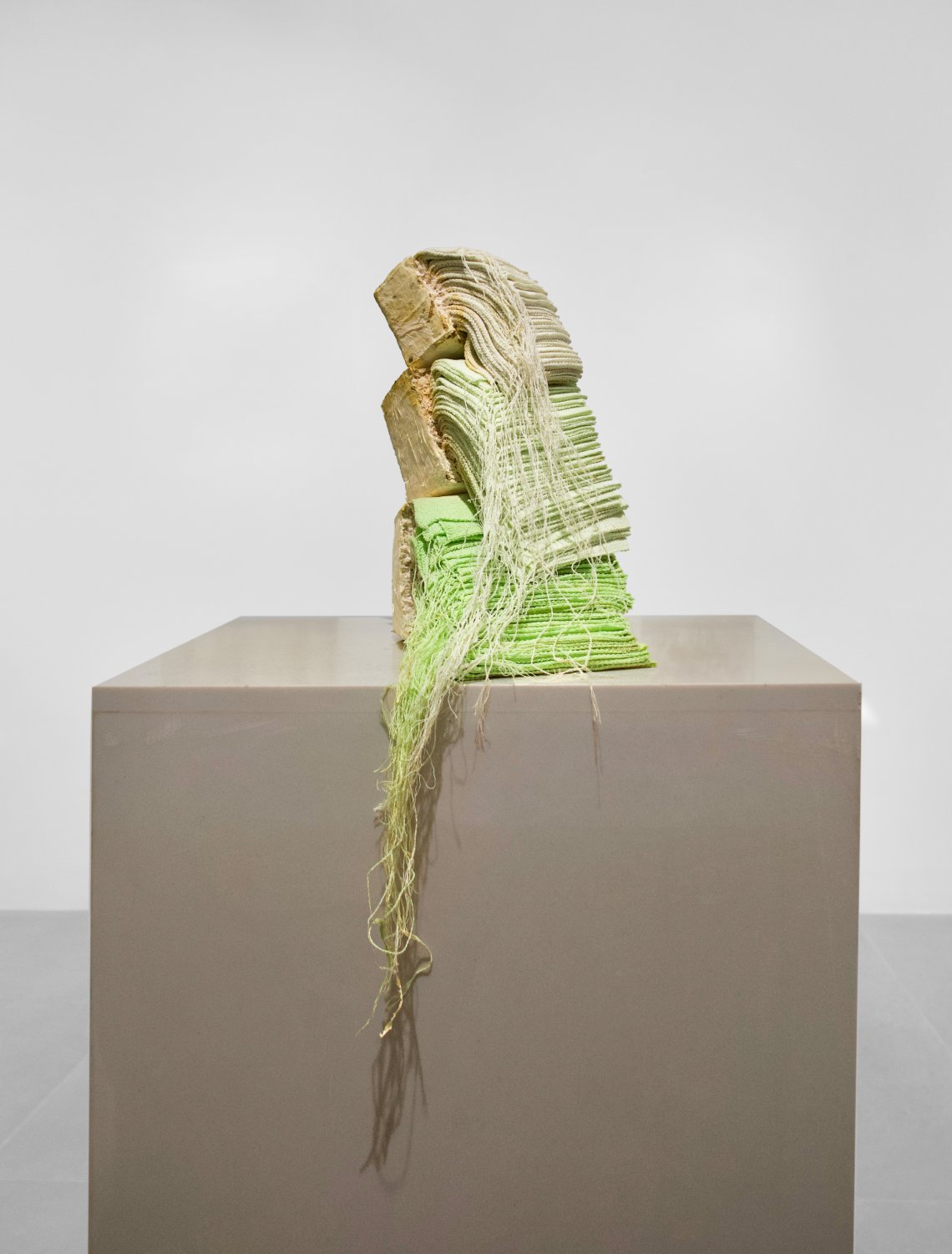
Artwork title : Symbiosis
Title: Symbiosis
Year: 2024
Medium: Textile, Straw, and Mycelium
Dimensions: 22*36*17cm
Zixiang Zhang's long-standing experience in textile art has made her aware that, due to industrialised production, textile waste is escalating at an alarming rate. The human-centred ecological solution results in vast quantities of discarded textiles being landfilled each year. However, burial is not the end of the life cycle of these textiles. They can build symbiotic relationships with natural life forms, such as fungi and microorganisms, in the soil and continue to exist in other ways. In Zixiang Zhang's work "Symbiosis" (2024), the entire work is composed solely of mycelium, straw, and knitted fabric. She attempted to utilise simple materials to interpret the close relationship between different materials. Moreover, she restored the process of knitted fabrics being buried, decomposed, swallowed, and regenerated, which prompted people to reflect on the impact of human activities on nature and to understand the core idea of removing the binary opposition between humans and nature in BioArt.
Furthermore, in the work "Symbiosis", the aim of choosing mycelium, straw, and textiles as creative media is to reflect the subtle connection between human-made and natural materials, rather than to conduct formal comparisons. The materials used correspond to different material systems. One type is the product of human industrial civilisation, represented by textile waste, from which people can clearly see the shadows of mass production, physical experience, and consumer society. The other type is mycelium and straw, which follow the life logic of decomposition, renewal, and regeneration, they are inseparable parts of nature.
Through the work "Symbiosis", viewers seem to witness the complete life cycle of the material. On the one hand, the mycelium can directly use the textile as a growth substrate, absorbing nutrients from it to sustain its growth, thereby giving the textile new life. On the other hand, the textile is gradually decomposed by the mycelium, eventually degrading into sustainable materials, hence making waste part of the natural cycle. This demonstrates that human waste gradually becomes part of the ecological cycle and becomes environmentally friendly as symbiotic relationships form, inspiring people to re-evaluate waste. Zixiang Zhang's purpose in creating this work is to guide people to redefine and understand "waste" and "resources". "Symbiosis", from its unique perspective, confirms the possibility of harmonious coexistence between waste and nature.

All right reserved - copyright © Malamegi Lab - www.lab.malamegi.com